
Extracellular nanovesicles for packaging of CRISPR-Cas9 protein and sgRNA to induce therapeutic exon skipping
Prolonged expression of the CRISPR-Cas9 nuclease and gRNA from viral vectors may cause off-target mutagenesis and immunogenicity. Thus, a transient delivery system is needed for therapeutic genome editing applications.
Read MoreFlow Electroporation Capabilities and Case Studies: Rapid GPCR Screening and Functional Ion Channel Assays.
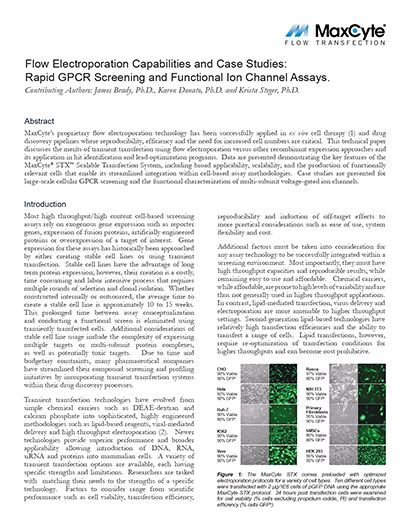
MaxCyte’s proprietary flow electroporation technology has been successfully applied in ex vivo cell therapy (1) and drug discovery pipelines where reproducibility, efficiency and the need for increased cell numbers are critical.
Read MoreGene editing in CHO cells to prevent proteolysis and enhance glycosylation: Production of HIV envelope proteins as vaccine immunogens
Several candidate HIV subunit vaccines based on recombinant envelope (Env) glycoproteins have been advanced into human clinical trials.
Read MoreGenerating therapeutic monoclonal antibodies to complex multi-spanning membrane targets: Overcoming the antigen challenge and enabling discovery strategies
Abstract: Complex integral membrane proteins, which are embedded in the cell surface lipid bilayer by multiple transmembrane spanning helices, encompass families of proteins which are important target classes for drug discovery. These protein families include G protein-coupled receptors, ion channels and transporters.
Read MoreDevelopment of Fully Scalable Reporter Gene Assays for Studying Transcriptional Regulation & Receptor Activation using Flow Electroporation
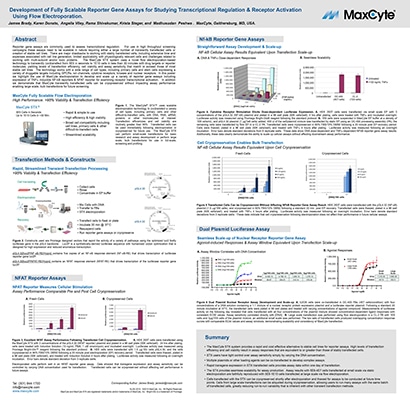
Reporter gene assays are commonly used to assess transcriptional regulation.
Read MoreGenome-Wide Analysis of Off-Target CRISPR/Cas9 Activity in Single-Cell-Derived Human Hematopoietic Stem and Progenitor Cell Clones
Prolonged expression of the CRISPR-Cas9 nuclease and gRNA from viral vectors may cause off-target mutagenesis and immunogenicity. Thus, a transient delivery system is needed for therapeutic genome editing applications.
Read MoreEfficient Cell Line Development and Genome Modification Using Flow Electroporation™ Technology
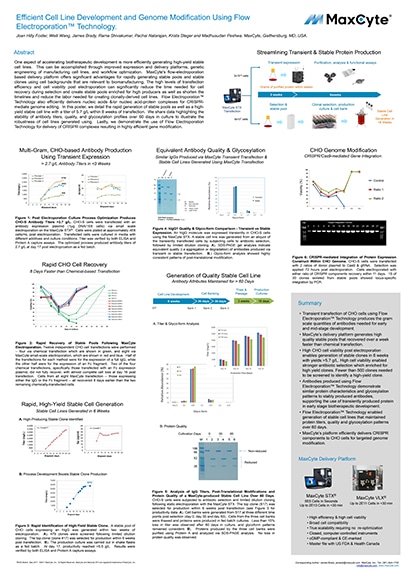
One aspect of accelerating biotherapeutic development is more efficiently generating high-yield stable cell lines. This can be accomplished through improved expression and delivery platforms, genetic engineering of manufacturing cell lines, and workflow optimization.
Read MoreElectroporation as a Cell Transfection Method for High Content Molecular Translocation Assay
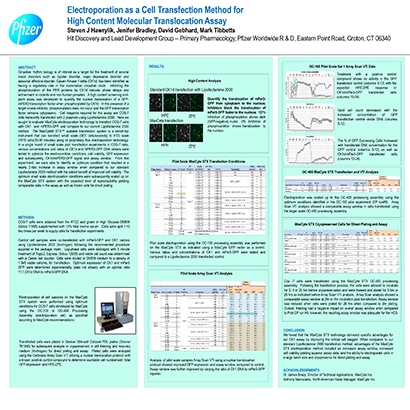
Circadian rhythm biology is of interest as a target for the treatment of several mood disorders such as bipolar disorder, major depressive disorder and seasonal affective disorder. Casein Kinase 1 delta (CK1d) has been identified as having a regulatory role in the mammalian circadian clock.
Read MoreGram Scale Transient Antibody Production and Stable Cell Line Generation Using Flow Electroporation™ Technology
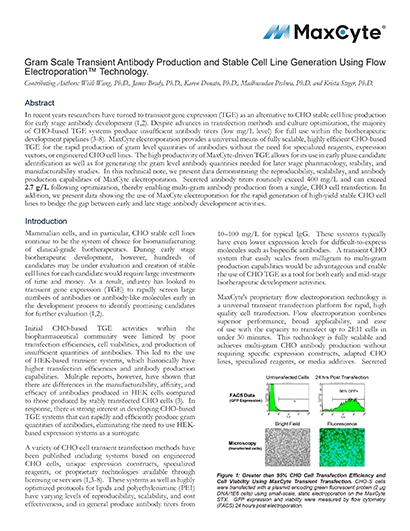
In recent years researchers have turned to transient gene expression (TGE) as an alternative to CHO stable cell line production for early stage antibody development (1,2).
Read MoreEnabling rapid and sensitive GPCR assay development with the MaxCyte® STX™ Scalable Transfection System and the Codex ACTOne biosensor technology
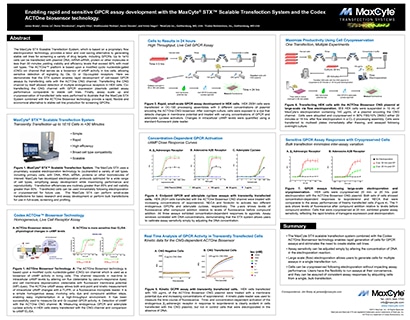
The MaxCyte STX Scalable Transfection System, which is based on a proprietary flow electroporation technology, provides a labor and cost saving alternative to generating stable cell lines for screening a variety of drug targets, including GPCRs.
Read More