
Fast Tracking Biotherapeutic Development Using Flow Electroporation Technology for Large-scale Transient Expression, Cell Line Generation and Genome Modification
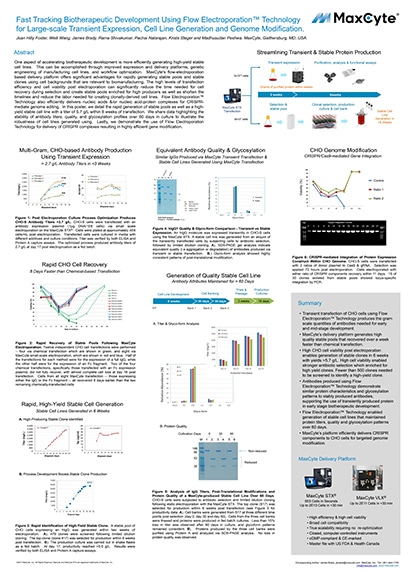
One aspect of accelerating biotherapeutic development is more efficiently generating high-yield stable cell lines. This can be accomplished through improved expression and delivery platforms, genetic engineering of manufacturing cell lines, and workflow optimization.
Read MoreDirected evolution of adenine base editors with increased activity and therapeutic application
The foundational adenine base editors (for example, ABE7.10) enable programmable A•T to G•C point mutations but editing efficiencies can be low at challenging loci in primary human cells.
Read MoreDisruption of the BCL11A Erythroid Enhancer Reactivates Fetal Hemoglobin in Erythroid Cells of Patients with b-Thalassemia Major
In the present report, we carried out clinical-scale editing in adult mobilized CD34+ hematopoietic stem and progenitor cells (HSPCs) using zinc-finger nuclease-mediated disruption of BCL11a to upregulate the expression of γ-globin (fetal hemoglobin).
Read MoreEffect of Tyrphostin AG879 on Kv4.2 and Kv4.3 Potassium Channels
A-type potassium channels (IA) are important proteins for modulating neuronal membrane excitability. The expression and activity of Kv4.2 channels are critical for neurological functions and pharmacological inhibitors of Kv4.2 channels may have therapeutic potential for Fragile X syndrome.
Read MoreEffectual Labeling of Natural Killer Cells with Upconverting Nanoparticles by Electroporation for In Vivo Tracking and Biodistribution Assessment
Effectual Labeling of Natural Killer Cells with Upconverting Nanoparticles by Electroporation for In Vivo Tracking and Biodistribution Assessment
Read MoreAccelerated Generation of Stable Pools & High-yield, Robust Stable Cell Lines Using MaxCyte Electroporation
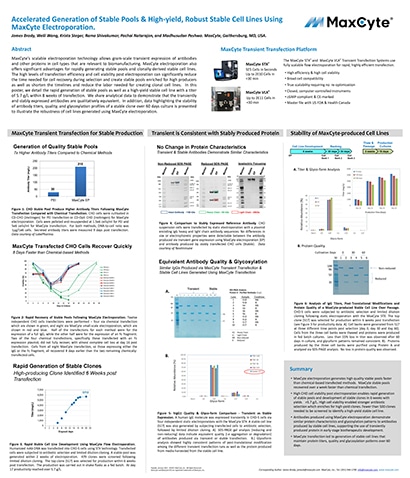
MaxCyte’s scalable electroporation technology allows gram-scale transient expression of antibodies and other proteins in cell types that are relevant to biomanufacturing.
Read MoreAdvancing High Throughput Screening of CFTR Modulators with Human Epithelial Cell Lines
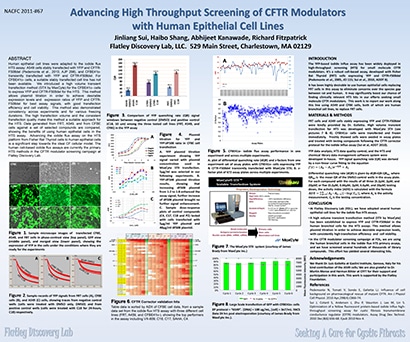
Human epithelial cell lines were adapted to the iodide flux HTS assay: A549 cells stably transfected with YFP and CFTR F508del (Pedemonte et al., 2010, AJP 298), and CFBE41o transiently transfected with YFP and CFTR-F508del. For CFBE41o- cells, a suitable stably transfected cell line has not been available.
Read MoreEfficient Electroporation of Neuronal Cells Using Synthetic Oligonucleotides: Identifying Duplex RNA and Antisense Oligonucleotide Activators of Human Frataxin Expression
Oligonucleotide drugs are experiencing greater success in the clinic, encouraging the initiation of new projects.
Read MoreEfficient Large Volume Lentiviral Vector Production Using Flow Electroporation
Lentiviral vectors are beginning to emerge as a viable choice for human gene therapy. Here, we describe a method that combines the convenience of a suspension cell line with a scalable, nonchemically based, and GMP-compliant transfection technique known as flow electroporation (EP).
Read MoreEfficient mRNA-based Genetic Engineering of Human NK Cells with High-Affinity CD16 and CCR7 Augments Rituximab-induced ADCC against Lymphoma and Targets NK cell Migration Towards the Lymph Node Associated Chemokine CCL19
For more than a decade, investigators have pursued methods to genetically engineer natural killer (NK) cells for use in clinical therapy against cancer.
Read More