
Efficient production of bispecific IgG of different isotypes and species of origin in single mammalian cells
Bispecific IgG production in single host cells has been a much sought-after goal to support the clinical development of these complex molecules.
Read MoreEfficient Responses in a Murine Renal Tumor Model by Electroloading Dendritic Cells With Whole-Tumor Lysate
Electroporation of dendritic cells (DCs) with tumor lysate elicited greater antitumor responses in vitro and in vivo, using less lysate than standard coincubation. Electroloaded DCs had normal surface marker expression and matured into competent antigen-presenting cells. In a renal carcinoma (RENCA) model, mice were pretreated with lysate-loaded DCs before tumor challenge.
Read MoreEfficient ssODN-Mediated Targeting by Avoiding Cellular Inhibitory RNAs through Precomplexed CRISPR-Cas9/sgRNA Ribonucleoprotein
Combined with CRISPR-Cas9 technology and single-stranded oligodeoxynucleotides (ssODNs), specific single-nucleotide alterations can be introduced into a targeted genomic locus in induced pluripotent stem cells (iPSCs)
Read MoreElectroporation Enables Oligonucleotide Delivery to Regulate Gene Expression in Friedrich’s Ataxia Patient-Derived Cells
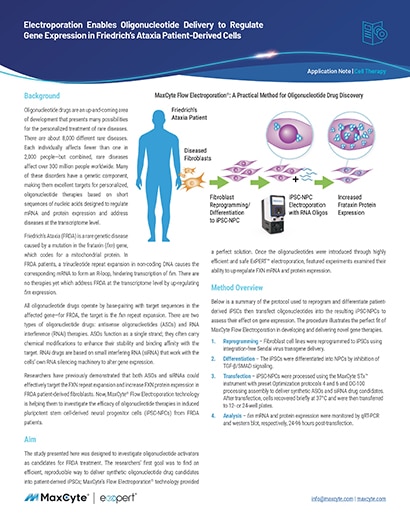
Oligonucleotide drugs are an up-and-coming area of development that presents many possibilities for the personalized treatment of rare diseases.
Read MoreAssay Development for Epigenetic Regulation of Histone 3 Lysine 36 Methylation using AlphaLISA
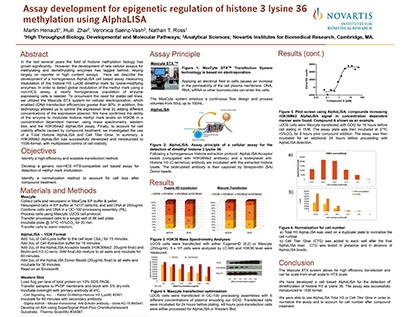
In the last several years the field of histone methylation biology has grown significantly. However, the development of new cellular assays for methylating and demethylating enzymes has lagged behind, relying largely on reporter or high content assays.
Read MoreEndothelial NO-Synthase Gene-Enhanced Progenitor Cell Therapy for Pulmonary Arterial Hypertension
Pulmonary arterial hypertension (PAH) remains a progressive and eventually lethal disease characterized by increased pulmonary vascular resistance because of loss of functional lung microvasculature, primarily at the distal (intracinar) arteriolar level.
Read MoreA nonviral, nonintegrating DNA nanovector platform for the safe, rapid, and persistent manufacture of recombinant T cells
The compelling need to provide adoptive cell therapy (ACT) to an increasing number of oncology patients within a meaningful therapeutic window makes the development of an efficient, fast, versatile, and safe genetic tool for creating recombinant T cells indispensable.
Read MoreA Pilot Study of Autologous Tumor Lysate-Loaded Dendritic Cell Vaccination Combined With Sunitinib For Metastatic Renal Cell Carcinoma
Background Sunitinib, a tyrosine kinase inhibitor currently in use for the treatment of metastatic renal cell carcinoma (mRCC), has been reported to modulate immunosuppressive cells such as myeloid-derived suppressor cells (MDSCs) and regulatory T cells (Tregs) in addition to exerting anti-angiogenic effects.
Read MoreA Scalable Cell-Loading System for Non-Viral Gene Delivery and Other Applications
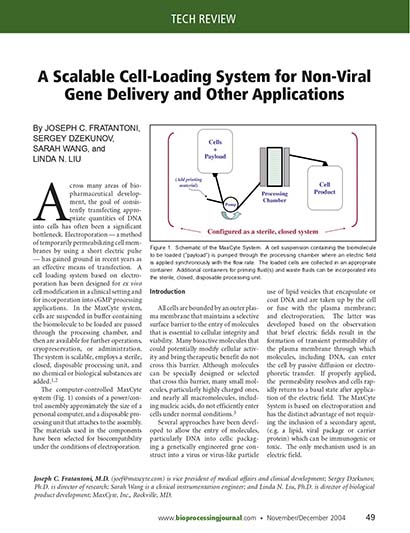
Across many areas of biopharmaceutical development, the goal of consistently transfecting appropriate quantities of DNA into cells has often been a significant bottleneck.
Read MoreAllosteric mechanism for KCNE1 modulation of KCNQ1 potassium channel activation
The Maxcyte STx delivered membrane proteins KCNQ1 and KCNE1 to CHO-K1 cells. High efficiency, transient co-transfection enabled the high-throughput data generation of an automated patch clamp system for time- and cost-efficient, automated electrophysiology and the construction of a new molecular model for potassium ion channel activation.
Read More